

男女共同参画学協会連絡会
支援企業による広告記事
- ソーラボジャパン株式会社
- CAD を使って光学装置を設計してみよう
- 「生物物理」2025年10月号
- ソーラボジャパン株式会社
- 次世代2光子顕微鏡―小型化がもたらす新たな可能性
- 「生物物理」2024年10月号
- ソーラボジャパン株式会社
- サイエンティフィックカメラと周辺機器の同期
- 「生物物理」2023年10月号
- ソーラボジャパン株式会社
- 顕微鏡のリノベーション ~ 顕微鏡ポートを活用した光学系の導入
- 「生物物理」2022年12月号
「Biophysics and Physicobiology」に Takuyo Aita, Yukino Ito, Kakeru Suzuki, Masatoshi Yamaguchi, Naoto Nemoto, Shigefumi Kumachi による "Massively parallel estimation of dissociation constant for ligand proteins using molecular display technologies and next-generation sequencing" をJ-STAGEの早期公開版として掲載
2026年09月26日 学会誌
日本生物物理学会欧文誌[Biophysics and Physicobiology]に以下の論文が早期公開されました。
Takuyo Aita, Yukino Ito, Kakeru Suzuki, Masatoshi Yamaguchi, Naoto Nemoto, Shigefumi Kumachi
"Massively parallel estimation of dissociation constant for ligand proteins using molecular display technologies and next-generation sequencing"
URL:https://doi.org/10.2142/biophysico.bppb-v23.0031
- Abstract
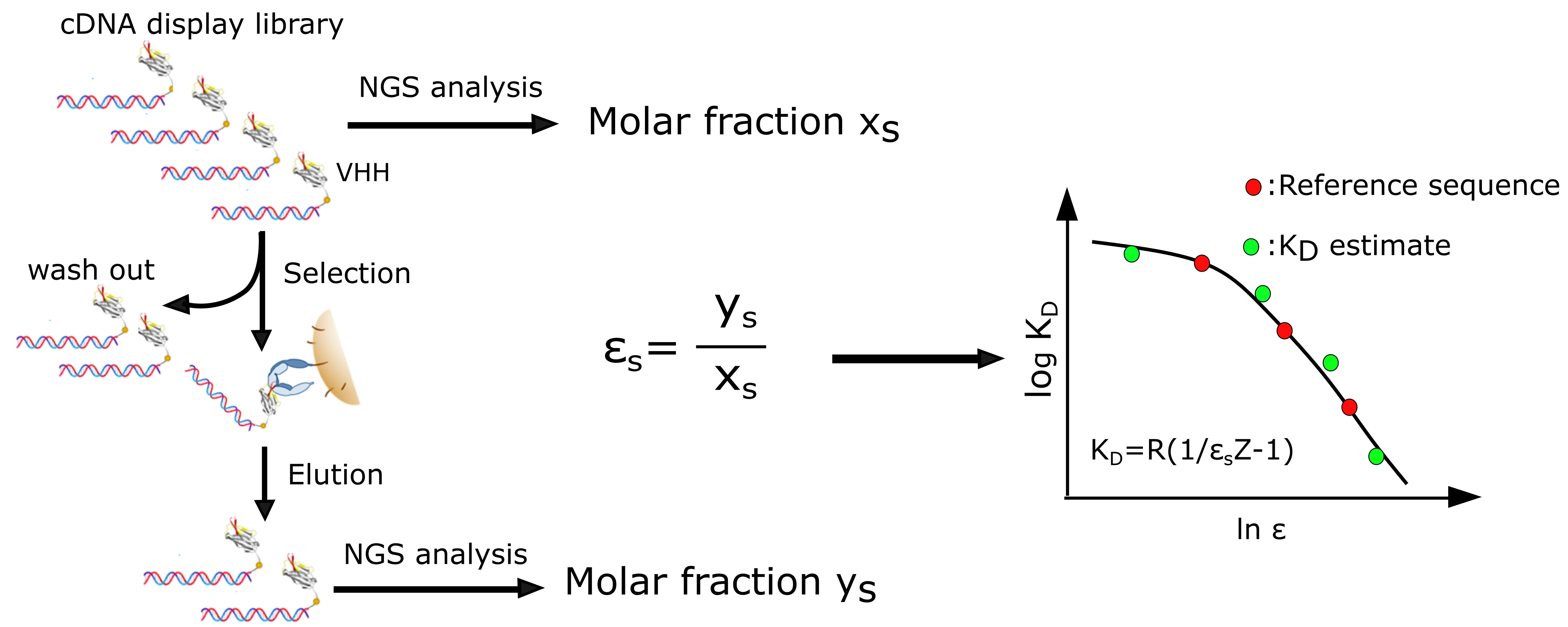
- For a vast library of ligand proteins, it is difficult to directly measure the dissociation constants KD of each ligand with its target receptor. We propose a massively parallel method to estimate KD values using “cDNA-display molecules”, in which the ligand protein is tagged with a cDNA molecule that represents its genotype. Our approach is based on fundamental equations governing chemical equilibrium and in vitro selection dynamics, and is quite straightforward. First, through a single selection process and subsequent next-generation sequencing (NGS), the “enrichment ratio” εs ≡ ys/xs for each sequence is calculated, where xs and ys are respectively the molar fraction of sequence s for immediately before selection and that for after selection. Next, KD values for several “reference sequences” chosen from the library are measured, and a calibration curve representing the relationship between ε and KD is obtained. Then, we can estimate KD values for other sequences based on their ε values. We applied the method to two different VHH libraries: one consists of local sequence space (Case 1) and the other consists of global sequence space (Case 2). To evaluate the validity of the method, the KD estimates for 6 - 28 reference sequences were compared with their measured values. As a result, the correlation coefficients between them were 0.98 for Case 1 and 0.79 for Case 2, suggesting that our method is highly effective. Theoretically, large-scale NGS increases the prediction accuracy, and then the method is expected to become more practical.
URL: https://doi.org/10.2142/biophysico.bppb-v23.0031