

男女共同参画学協会連絡会
支援企業による広告記事
- ソーラボジャパン株式会社
- CAD を使って光学装置を設計してみよう
- 「生物物理」2025年10月号
- ソーラボジャパン株式会社
- 次世代2光子顕微鏡―小型化がもたらす新たな可能性
- 「生物物理」2024年10月号
- ソーラボジャパン株式会社
- サイエンティフィックカメラと周辺機器の同期
- 「生物物理」2023年10月号
- ソーラボジャパン株式会社
- 顕微鏡のリノベーション ~ 顕微鏡ポートを活用した光学系の導入
- 「生物物理」2022年12月号
「Biophysics and Physicobiology」に Miftakhul Firdhaus, Ulya Farahdina, Nasori Nasori, Endarko Endarko, Agus Rubiyanto による "Comparative evaluation of electrode configuration for optimizing positive dielectrophoresis trapping of CCRF-CEM cells" をJ-STAGEの早期公開版として掲載
2026年02月17日 学会誌
日本生物物理学会欧文誌[Biophysics and Physicobiology]に以下の論文が早期公開されました。
Miftakhul Firdhaus, Ulya Farahdina, Nasori Nasori, Endarko Endarko, Agus Rubiyanto
"Comparative evaluation of electrode configuration for optimizing positive dielectrophoresis trapping of CCRF-CEM cells"
URL:https://doi.org/10.2142/biophysico.bppb-v23.0006
- Abstract
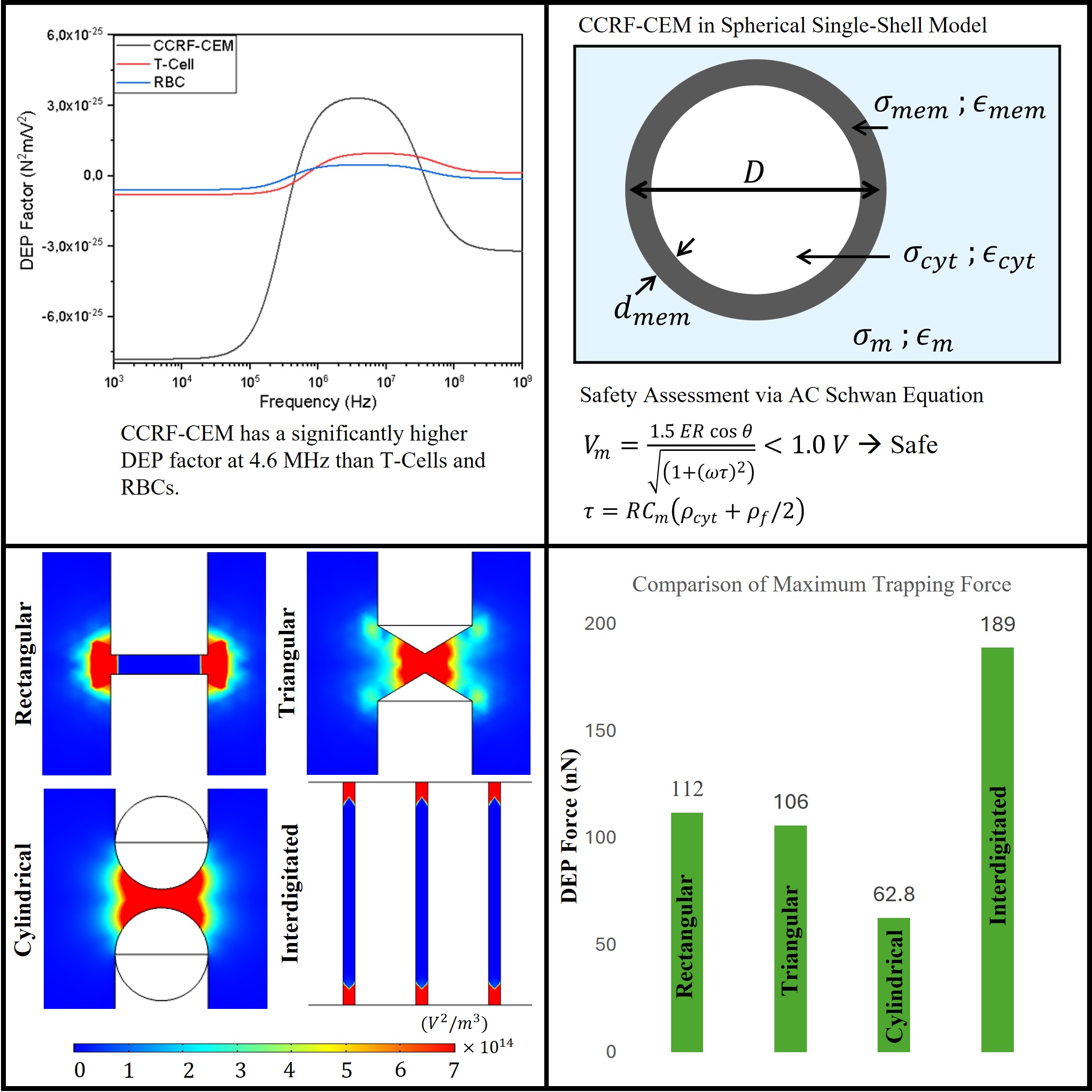
- Dielectrophoresis (DEP) is a promising label-free technique for bioparticle manipulation, offering significant potential for diagnostic application such as isolation and trapping of cancerous CCRF-CEM cells. The efficacy of DEP trapping is critically dependent on the interaction between the cell’s dielectric properties and the spatial gradient of the squared electric field (∇|E2|), which is governed by electrode geometry. This study conducts a comparative evaluation, via finite element method (FEM) analysis, to quantify the positive dielectrophoresis (pDEP) force exerted on CCRF-CEM cells. Four distinct electrode configurations were analyzed: parallel (rectangular, triangular, cylindrical) and interdigitated. Based on a single-shell model for CCRF-CEM cells within a low-conductivity buffer, the Clausius-Mossotti factor was determined at 4.6 MHz, confirming a strong pDEP response that attracts cells to high-field regions. Results demonstrate that the pDEP force scales quadratically with applied voltage and is significantly enhanced by reducing the electrode gap. At a standardized 25 Vpp and 100 µm gap, the interdigitated configuration generated the highest maximum pDEP force, substantially exceeding the parallel rectangular, triangular, and cylindrical designs. Furthermore, the interdigitated geometry produced the most extensive and uniform high-force zones along the electrode edges, creating a superior trapping area. This comparative evaluation provides quantitative guidelines for optimizing electrode design, identifying the interdigitated configuration as the most effective for developing high-efficiency microdevices for CCRF-CEM cell trapping.
URL: https://doi.org/10.2142/biophysico.bppb-v23.0006