

男女共同参画学協会連絡会
支援企業による広告記事
- ソーラボジャパン株式会社
- CAD を使って光学装置を設計してみよう
- 「生物物理」2025年10月号
- ソーラボジャパン株式会社
- 次世代2光子顕微鏡―小型化がもたらす新たな可能性
- 「生物物理」2024年10月号
- ソーラボジャパン株式会社
- サイエンティフィックカメラと周辺機器の同期
- 「生物物理」2023年10月号
- ソーラボジャパン株式会社
- 顕微鏡のリノベーション ~ 顕微鏡ポートを活用した光学系の導入
- 「生物物理」2022年12月号
「Biophysics and Physicobiology」に Ritsu Mizutori, Masahiro Sugiura, Hideki Kandori による "Protonation states of highly conserved carboxylic acids in NeoR" をJ-STAGEの早期公開版として掲載
2025年12月06日 学会誌
日本生物物理学会欧文誌[Biophysics and Physicobiology]に以下の論文が早期公開されました。
Ritsu Mizutori, Masahiro Sugiura, Hideki Kandori
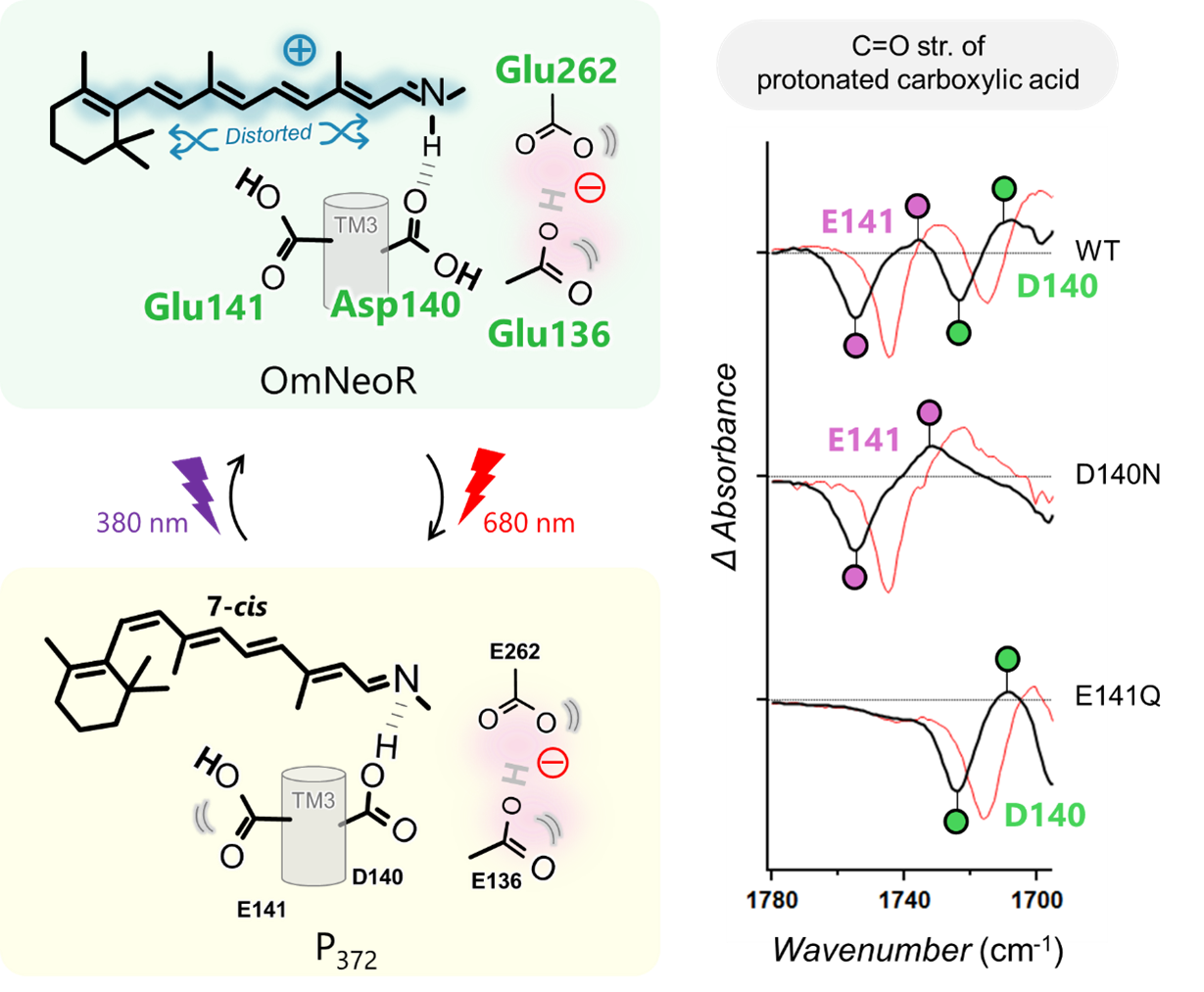
"Protonation states of highly conserved carboxylic acids in NeoR"
URL:https://doi.org/10.2142/biophysico.bppb-v22.0032
- Abstract
- Neorhodopsin (NeoR), an enzymerhodopsin, has unique molecular properties. NeoR absorbs near-infrared light whose λmax is located at 690-700 nm. Upon light absorption, NeoR is photoisomerized into the 7-cis form with low quantum yield. Unique color-tuning and photoreaction mechanism of NeoR is owing to the residues surrounding the all-trans retinal chromophore. In NeoR, three carboxylates, E136, D140, and E262, constitute a counterion triad near the retinal Schiff base, and E141 is located near the β-ionone ring. Despite recent experimental and theoretical studies, protonation states of the highly conserved four carboxylates have never been experimentally determined. In this study, we performed comprehensive mutation analysis of NeoR by UV-visible and FTIR spectroscopy. We prepared E136Q, D140N, E141Q, and E262Q mutants of an NeoR. Among four mutants, only E262Q did not form a pigment, suggesting that E262 is the principal Schiff base counterion. Light-induced FTIR spectroscopy detected two bands of protonated carboxylic acids, and vibrational bands were identified as protonated D140 and E141. Hydrogen bond of D140 is strong in NeoR, which is further strengthened upon photoisomerization into the 7-cis form. The Schiff base is the possible hydrogen-bonding partner of D140. Hydrogen bond of E141 is very weak in NeoR, but E141 newly forms a hydrogen bond upon 7-cis isomerization. Protonation states of E136 and E262 were not determined conclusively, whereas the present FTIR study suggests that one negative charge is delocalized at E136 and E262 that contributes to unusual spectral red-shift in NeoR. Four carboxylates near the retinal chromophore in NeoR play their own roles in unique color-tuning and photoreaction mechanism.
URL: https://doi.org/10.2142/biophysico.bppb-v22.0032