 Biophysics and Physicobiology
- HOME
- Story of the Cover
Story of the Cover
Spatial adjacency of β-subunit governs F-actin binding of CaMKIIα/β heterooligomers: A statistical mechanical modeling
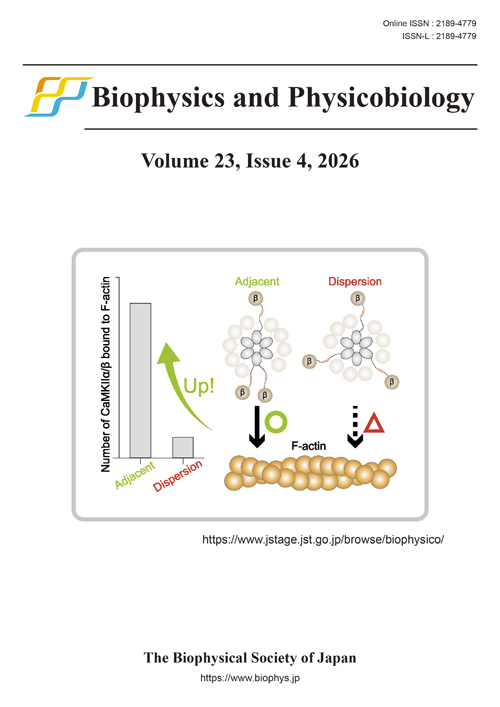
(Keisuke Matsushima, Takashi Sumikama, Mikihiro Shibata, Biophysics and Physicobiology 23, e230034 (2026), DOI: 10.2142/biophysico.bppb-v23.0034)
How multimeric enzymes exploit subunit arrangement to tune their function remains poorly understood. CaMKII, a key regulator of synaptic plasticity, forms α/β heterododecamers that bind F-actin through their β subunits. High-speed atomic force microscopy has shown that these subunits preferentially occupy adjacent positions. Statistical mechanical modeling reveals the functional consequence of this non-random organization: adjacent β subunits engage the filament simultaneously, yielding a 7.3-fold increase in F-actin-bound heterooligomers relative to a dispersed arrangement. Spatial adjacency, rather than subunit number, thus emerges as the principal determinant of F-actin binding, enabling holoenzymes with few β subunits to remain anchored to the cytoskeleton.