 Biophysics and Physicobiology
- HOME
- Story of the Cover
Story of the Cover
Denoising for high-magnification bioluminescence imaging of cells by machine learning with physics-based noise modeling of EMCCD
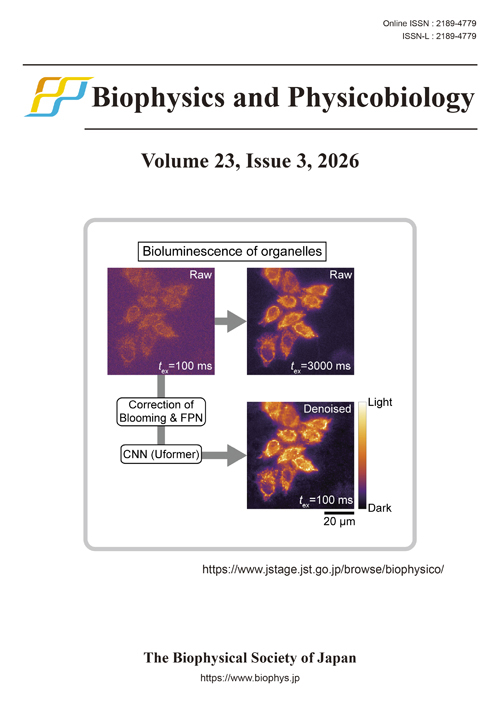
(Tetsuichi Wazawa, Haiyang Jiang, Ryohei Ozaki-Noma, Yinqiang Zheng, Imari Sato, Takeharu Nagai, Biophysics and Physicobiology 23, e230025 (2026), DOI: 10.2142/biophysico.bppb-v23.0025)
Bioluminescence imaging (BLI) visualizes luciferase-labeled samples through light emitted by the luciferin–luciferase reaction. Unlike fluorescence imaging, BLI requires no excitation light and therefore eliminates phototoxicity and photobleaching. However, its widespread application has been hindered by the intrinsically low photon emission rate of luciferases, which results in poor image quality under photon-limited conditions. Here, we present a machine learning–based denoising framework for BLI that incorporates physics-based modeling of EMCCD noise. The framework corrects five major noise components in raw EMCCD images and substantially improves image quality. Notably, denoised images acquired with exposure times as short as 100 ms achieved image quality comparable to that of raw images acquired at 3,000 ms, corresponding to an approximately 30-fold reduction in exposure time. This approach substantially extends the practical capabilities of BLI and opens new opportunities for high-resolution, high-magnification imaging of dynamic biological processes in living cells.