 Biophysics and Physicobiology
- HOME
- Story of the Cover
Story of the Cover
Mechanistic insights into a cold-adapted glucokinase with high thermal stability were revealed by site-directed spin labeling ESR
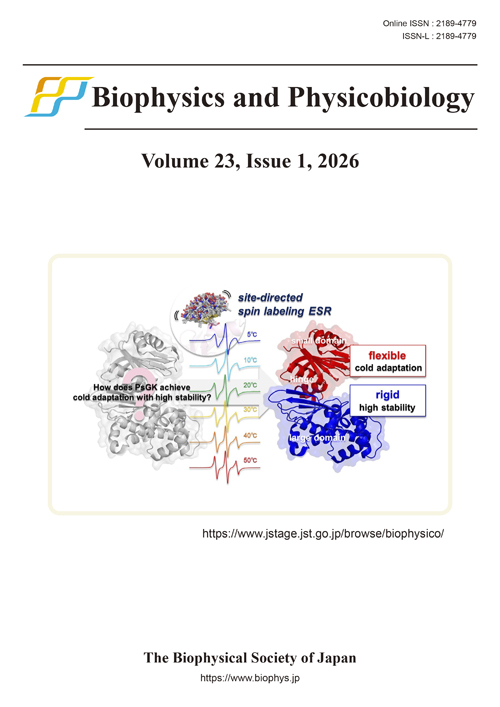
(Akane Yato, Masaki Horitani, Biophysics and Physicobiology 23, e230005 (2026), DOI: 10.2142/biophysico.bppb-v23.0005)
Cold-adapted glucokinase from Pseudoalteromonas sp. AS-131 (PsGK) achieves both high catalytic efficiency and unusually high thermal stability. Using site-directed spin labeling electron spin resonance (SDSL-ESR), we revealed that PsGK enhances flexibility selectively in the small domain and hinge region, while maintaining a relatively rigid large domain. In contrast, the mesophilic counterpart from Escherichia coli exhibited uniformly lower flexibility without domain-specific variation. Substrate binding increased overall rigidity of both enzymes, yet PsGK retains localized flexibility in key regions. These findings demonstrate that optimizing catalytic activity requires site-specific flexibility rather than global structural flexibility. This provides new insight into the balance between activity and stability in cold-adapted enzymes.