
"Structural dynamics of G626A Wilson disease ATP7B protein in complex with chaperone Atox1 revealed by molecular dynamics simulations" by Mingwei Li, Ting Cheng, Chengtao Ding, Jiachen Yang, Wenming Yang, Yujun Liu, Shuwen Xu is published in BPPB as the J-STAGE Advance Publication.
2026 November 20 BPPB
A following article is published as the J-STAGE Advance Publication in "Biophysics and Physicobiology".
Mingwei Li, Ting Cheng, Chengtao Ding, Jiachen Yang, Wenming Yang, Yujun Liu, Shuwen Xu
"Structural dynamics of G626A Wilson disease ATP7B protein in complex with chaperone Atox1 revealed by molecular dynamics simulations"
URL:https://doi.org/10.2142/biophysico.bppb-v23.0038
- Abstract
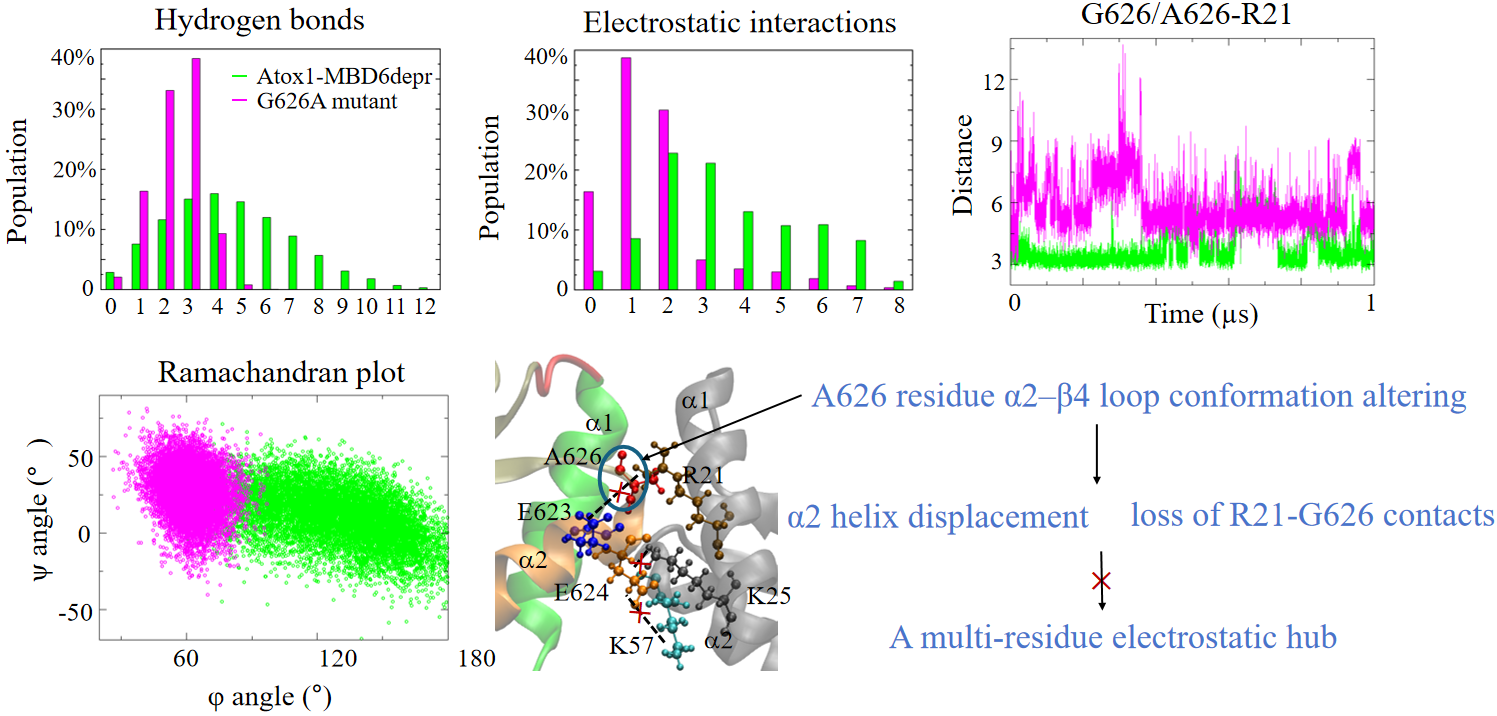
- The human transporter ATP7B maintains hepatic copper homeostasis by specific binding of its sixth metal-binding domain (MBD6) to the copper chaperone Atox1. The G626A mutation in MBD6 causes Wilson disease (WD), a disorder with hepatic and neurological manifestations. However, the molecular mechanism underlying the WD-associated G626A mutation remains poorly understood. To address this, we conducted molecular dynamics simulations and free energy calculations to explore the structural dynamics of the Atox1-MBD6 complex. Our findings show that deprotonation of C575 and C578 in MBD6 upon Cu(I) binding enhances the conformational stability of Atox1–Cu(I)–MBD6 complex. Importantly, the G626A mutation disrupts the critical hydrogen bond between G626 and R21 and weakens the electrostatic interaction network linking MBD6 residues E623/E624 to Atox1 residues R21/K25/K57, which ultimately reduces the interaction stability and structural integrity of the Atox1–Cu(I)–MBD6 complex. Our study offers valuable insights into the structural dynamics and stability of the Atox1-MBD6 complex, linking the WD mutation to protein dysfunction.