
"Composition dependent effects of charged lipids on freeze-thaw induced fusion in dioleoyl phospholipid membranes" by Gakushi Tsuji is published in BPPB as the J-STAGE Advance Publication.
2026 August 01 BPPB
A following article is published as the J-STAGE Advance Publication in "Biophysics and Physicobiology".
Gakushi Tsuji
"Composition dependent effects of charged lipids on freeze-thaw induced fusion in dioleoyl phospholipid membranes"
URL:https://doi.org/10.2142/biophysico.bppb-v23.0026
- Abstract
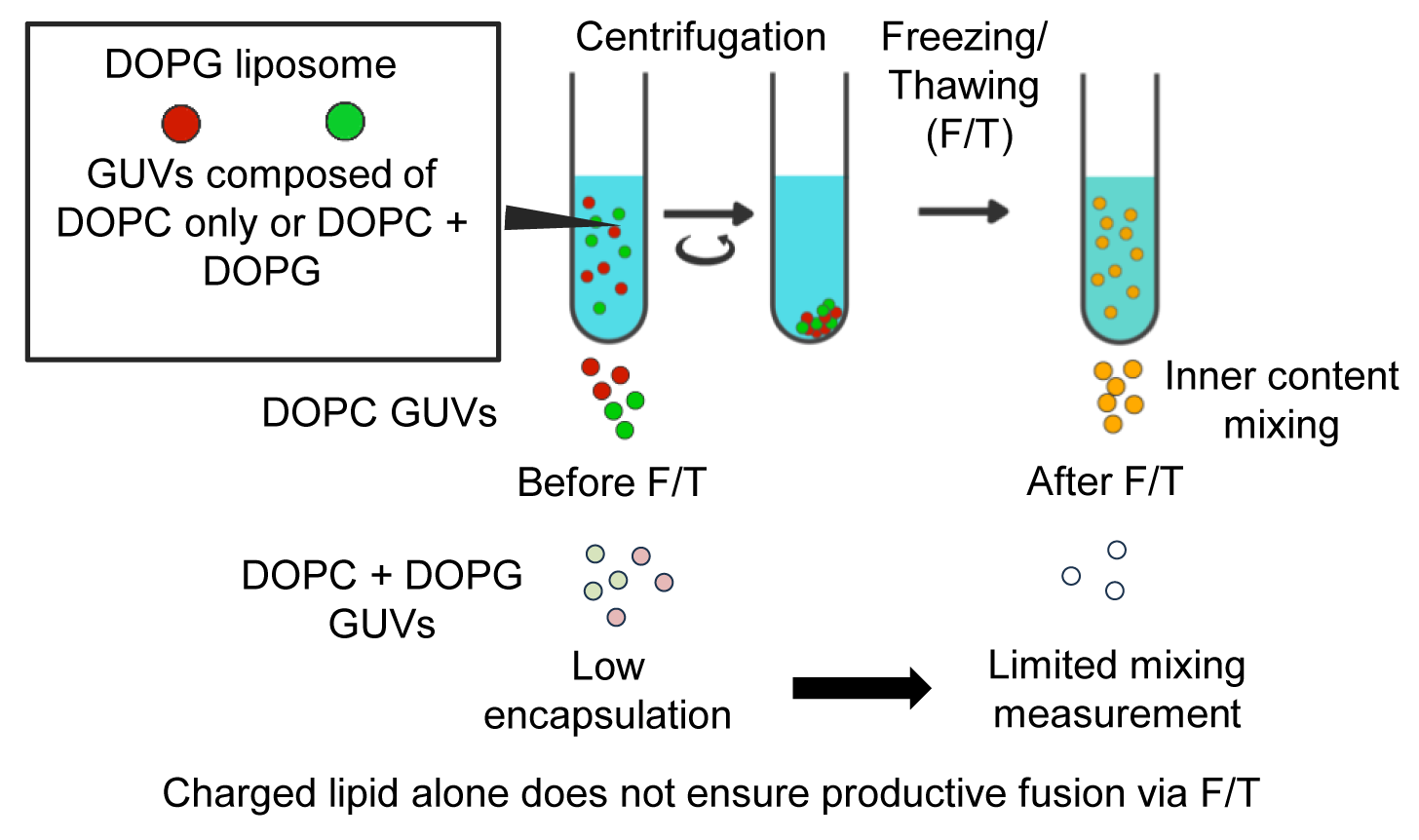
- Artificial cells based on giant unilamellar vesicles (GUVs) provide a platform for reconstituting biochemical reactions within membrane-bound compartments. However, limited membrane permeability restricts substrate exchange, leading to depletion during prolonged reactions. Freeze-thaw (F/T) treatment has been used to overcome this limitation by enabling liposome fusion and content exchange. Here, we systematically investigated F/T-induced fusion in dioleoylphosphatidylcholine (DOPC) liposomes with negatively charged dioleoylphosphatidylglycerol (DOPG) and positively charged dioleoyltrimethylammoniumpropane (DOTAP). DOPC liposomes exhibited internal content mixing comparable to POPC-based systems, whereas DOPG incorporation reduced encapsulation efficiency and did not enhance fusion, indicating that charge-mediated effects are not universal. In DOPC/DOTAP liposomes, dual-fluorescent populations detected by flow cytometry were largely attributed to membrane adsorption and aggregation rather than true internal content mixing, as confirmed by fluorescence microscopy. Although limited mixing occurred at low DOTAP fractions, higher DOTAP content promoted non-productive interactions. These results demonstrate that electrostatic interactions alone are insufficient to drive productive fusion and that fusion behavior depends strongly on lipid composition. In particular, hydrophobic acyl-chain structure, in addition to headgroup charge, plays a critical role in determining fusion efficiency and compartment stability.