
"PTM-associated condensation of homopolymeric (poly A) RNA by MDP1" by Nadia Shoukat, Akihito Nishiyama, Kaho Nakamoto, Hikaru Ichida, Kenichi Umeda, Sohkichi Matsumoto, Noriyuki Kodera is published in BPPB as the J-STAGE Advance Publication.
2026 August 01 BPPB
A following article is published as the J-STAGE Advance Publication in "Biophysics and Physicobiology".
Nadia Shoukat, Akihito Nishiyama, Kaho Nakamoto, Hikaru Ichida, Kenichi Umeda, Sohkichi Matsumoto, Noriyuki Kodera
"PTM-associated condensation of homopolymeric (poly A) RNA by MDP1"
URL:https://doi.org/10.2142/biophysico.bppb-v23.0027
- Abstract
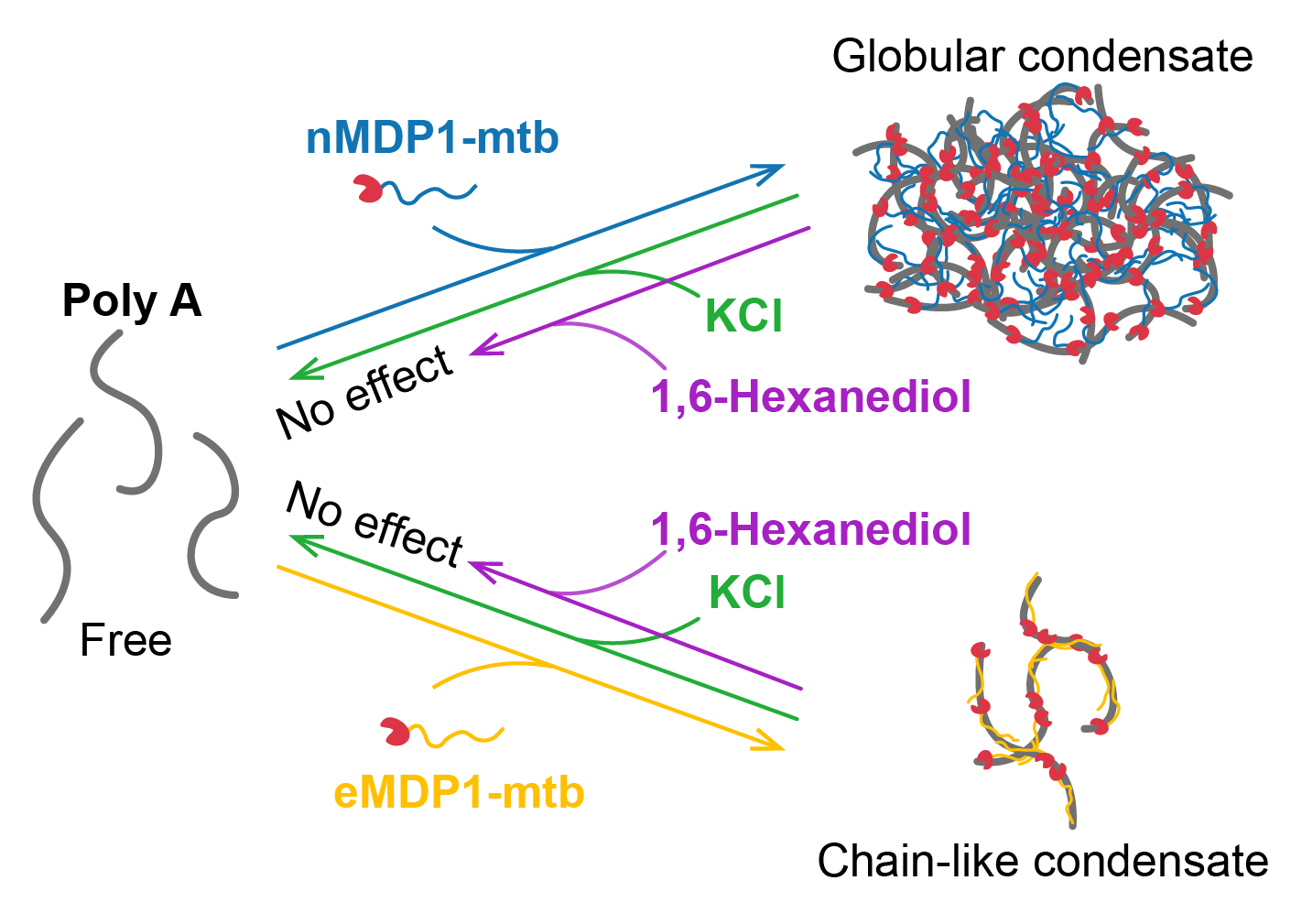
- Mycobacterial DNA binding protein 1 (MDP1) is a histone-like protein which carries endogenous post translational modifications (PTMs) and contributes to nucleic acid organization in Mycobacterium tuberculosis (Mtb). Our previous work using total RNA (a heterogeneous mixture of RNA substrates) established that MDP1 induces RNA condensation, but the structural diversity of total RNA makes it difficult to fully resolve protein intrinsic condensation behavior and the interactions stabilizing the resulting condensates. To minimize substrate dependent effects, we used polyadenylic acid (poly A) RNA as a uniform model substrate and compared native MDP1 purified from Mtb (nMDP1-mtb), which retains its natural PTMs, with recombinant MDP1 expressed in Escherichia coli (eMDP1-mtb), which majorly lacks these modifications. Optical microscopy and high speed AFM revealed that native and recombinant MDP1 induce distinct condensate morphologies: nMDP1-mtb induces compact globular condensates, whereas eMDP1-mtb induces elongated chain like condensates. Increasing ionic strength rapidly dissolved condensates formed by both proteins, while 1,6 hexanediol had minimal effects, demonstrating that electrostatic interactions dominate condensate stabilization. These findings show that PTM associated differences in MDP1 shape poly A RNA condensate morphology, while both protein forms rely on a shared electrostatic mechanism, contributing to a better understanding of MDP1-mediated RNA organization.