
"FTIR study of the wild-type and mutant proteins of a viral rhodopsin, OLPVR1" by Mako Aoyama, Kota Katayama, Hideki Kandori is published in BPPB as the J-STAGE Advance Publication.
2025 November 12 BPPB
A following article is published as the J-STAGE Advance Publication in "Biophysics and Physicobiology".
Mako Aoyama, Kota Katayama, Hideki Kandori
"FTIR study of the wild-type and mutant proteins of a viral rhodopsin, OLPVR1"
URL:https://doi.org/10.2142/biophysico.bppb-v22.0029
- Abstract
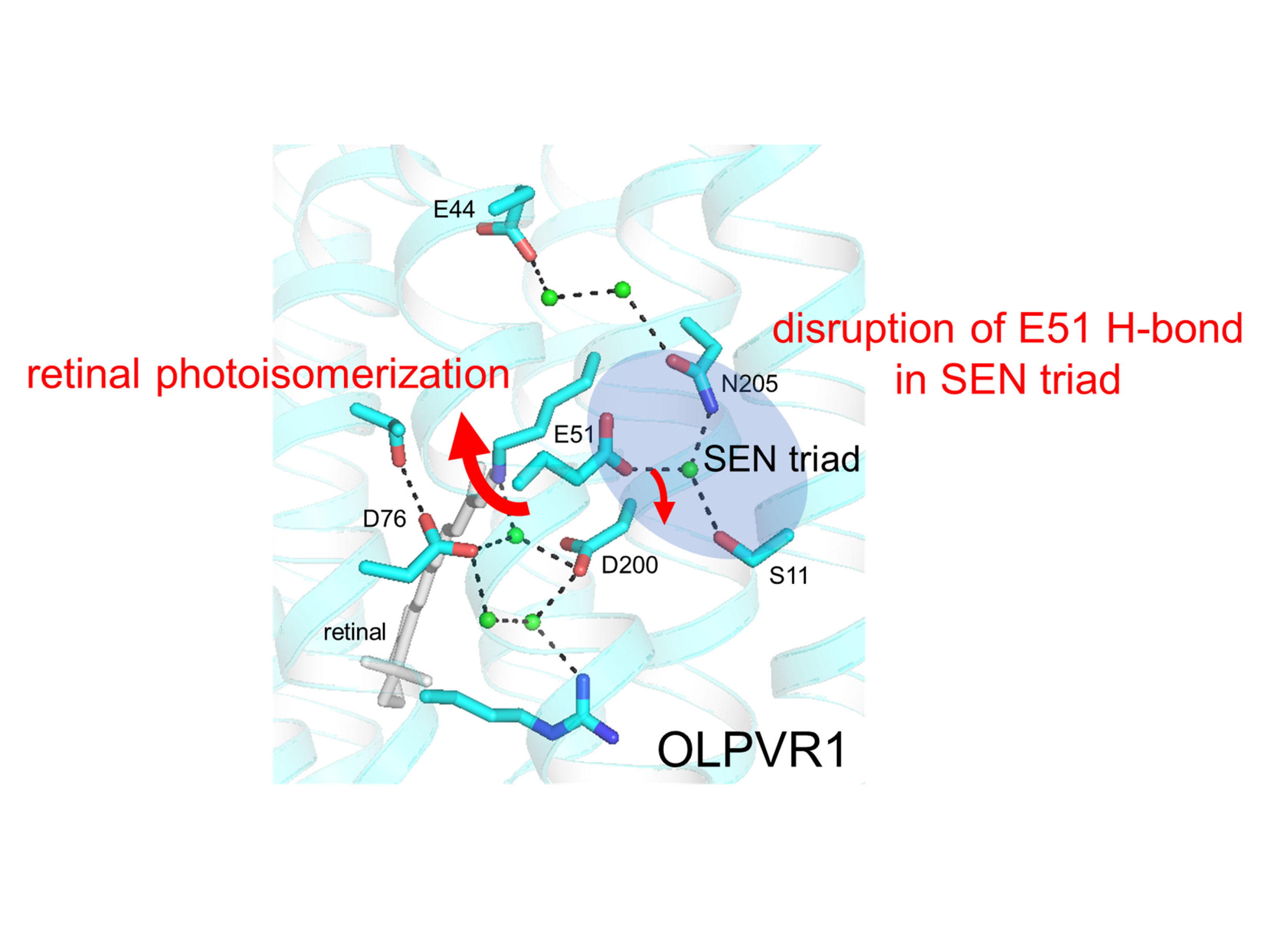
- OLPVR1 is a viral channelrhodopsin found in giant viruses, which can be a useful optogenetic tool for calcium-regulated cell functions. Determination of the open-state structure leads to one of the best understood channelrhodopsins. Recent FTIR spectroscopy of OLPVR1 reported unique structures in the resting and photoisomerized states at 77 K. Here we attempted to obtain difference FTIR spectra of mutants in OLPVR1, where we focused six key residues, S11, E44, E51, D76, D200, and N205. We prepared S11T, E51D, E51Q, N205Q, E44Q, D76N, and D200N, to which spectroscopic analysis was applied. From the lmax values of D76N and D200N at pH 7 and 8, it was concluded that D200 is the primary counterion. FTIR spectroscopy showed that the carboxylic C=O stretch of WT at 1722 (-)/1707 (+) cm-1 in H2O, and at 1718 (-)/1698 (+) cm-1 in D2O disappeared in E51Q, from which protonation of E51 was concluded. S11T and N205Q alter the C=O stretch frequency of E51 in the dark, but not in the photoisomerized state at 77 K. This observation implicates that E51 interacts with S11 and N205 through a water-containing hydrogen bond, whereas the interaction is broken by light. Recent crystallographic study visualized flipping motion of E51 upon opening state of OLPVR1, and the present FTIR study reports the removal of E51 from the network with S11 and N205 occurring even at the primary photoreaction stage. Retinal photoisomerization accompanies hydrogen-bonding switch of E51, leading to channel opening of OLPVR1 in late timescale.