
"Origin of the unique topology of the triangular water cluster in Rubrobacter xylanophilus rhodopsin" by Tomoyasu Noji, Msasaki Tsujimura, Keisuke Saito, Keiichi Kojima, Yuki Sudo, Hiroshi Ishikita is published in BPPB as the J-STAGE Advance Publication.
2025 August 23 BPPB
A following article is published as the J-STAGE Advance Publication in "Biophysics and Physicobiology".
Tomoyasu Noji, Msasaki Tsujimura, Keisuke Saito, Keiichi Kojima, Yuki Sudo, Hiroshi Ishikita
"Origin of the unique topology of the triangular water cluster in Rubrobacter xylanophilus rhodopsin"
URL:https://doi.org/10.2142/biophysico.bppb-v22.0018
- Abstract
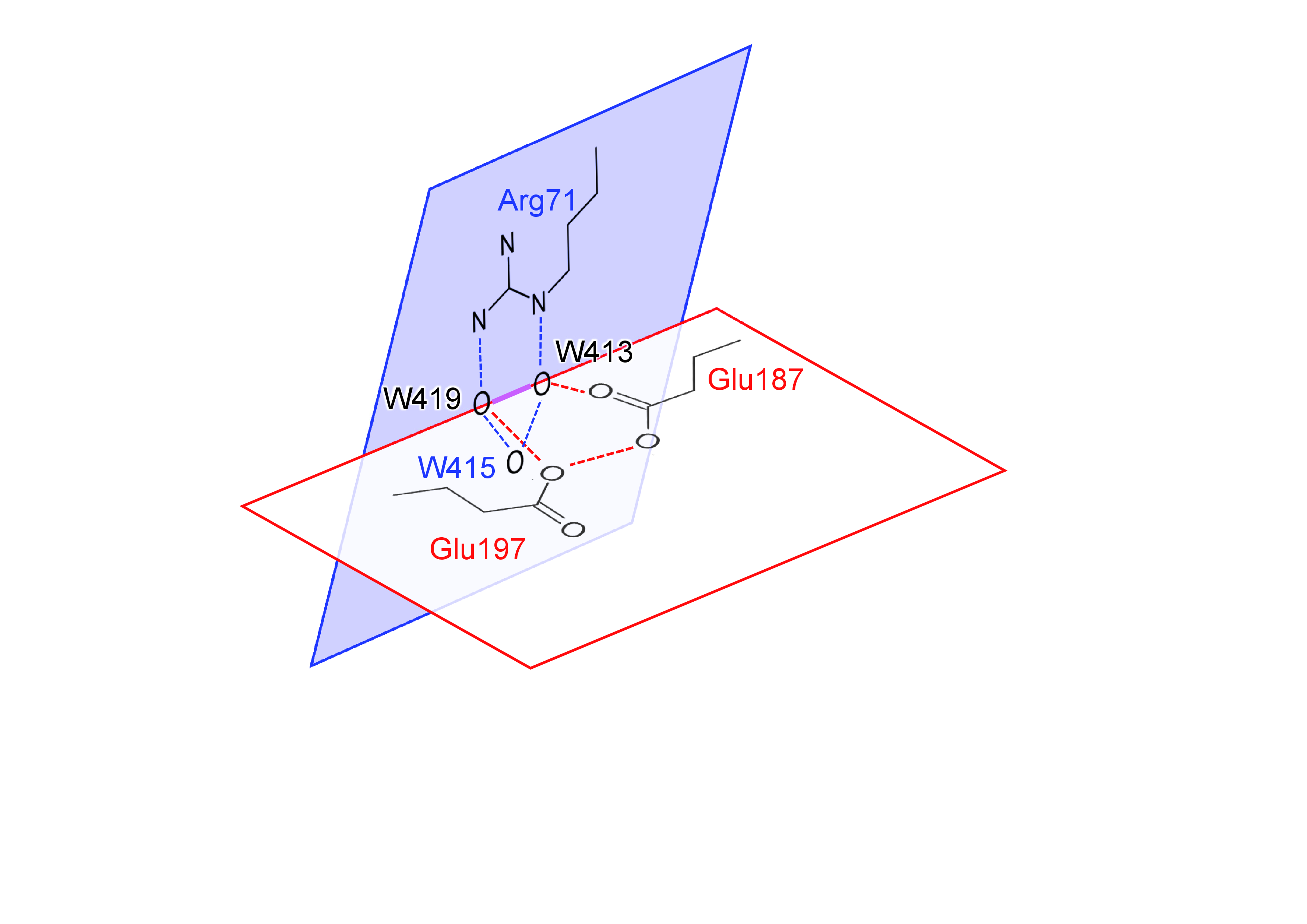
- The crystal structure of Rubrobacter xylanophilus rhodopsin (RxR) reveals a triangular cluster of three water molecules (W413, W415, and W419) at the extracellular proton-release site, near Glu187 and Glu197. Using a quantum mechanical/molecular mechanical approach, we identified the structural nature of this unique water cluster. The triangular shape is best reproduced when all three water molecules are neutral H2O with protonated Glu187 and deprotonated Glu197. Attempts to place H3O+ at any of these water molecules result in spontaneous proton transfer to one of the acidic residues and significant distortion from the crystal structure. The plane defined by the triangular water cluster extends into the guanidinium plane of Arg71, with both aligned along the W413...W419 axis. This extended plane lies nearly perpendicular to a five-membered, ring-like H-bond network involving two carboxyl oxygen atoms from Glu187 and one from Glu197. The resulting bipartite planar architecture, defined by the water triangle, Arg71, and the Glu187/Glu197 network may reflect the exceptional thermal stability in RxR.