
"Polymerization and stability of actin conjugated with polyethylene glycol" by Masaya Sagara, Kuniyuki Hatori is published in BPPB as the J-STAGE Advance Publication.
2025 August 08 BPPB
A following article is published as the J-STAGE Advance Publication in "Biophysics and Physicobiology".
Masaya Sagara, Kuniyuki Hatori
"Polymerization and stability of actin conjugated with polyethylene glycol"
URL:https://doi.org/10.2142/biophysico.bppb-v22.0017
- Abstract
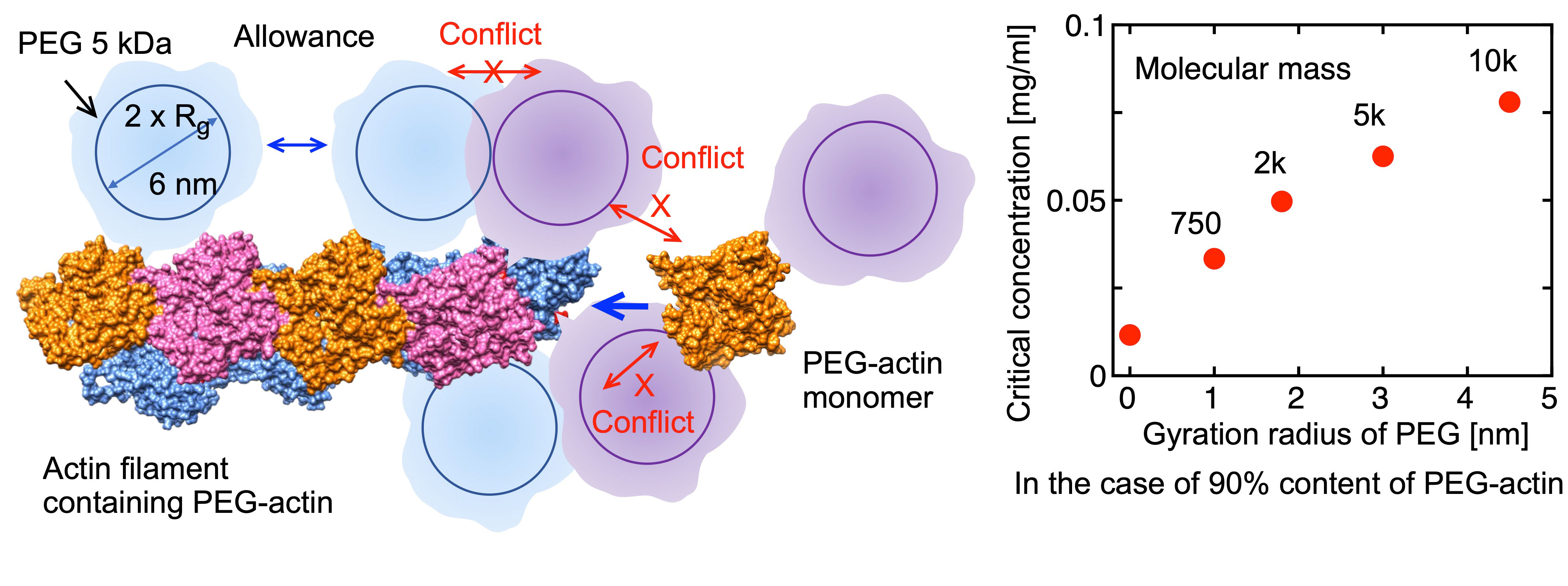
- This study aimed to elucidate the impact of polyethylene glycol (PEG) conjugation on protein-protein interactions by investigating the properties of PEG-conjugated actin (PEG-actin). Various PEG molecules were covalently bound to actin monomers by reacting maleimide groups with Cys374 on the actin. The apparent polymerization rate constant (konapp) and the critical concentration (Cc) were measured by fluorescence spectroscopy using pyrene-labeled actin, as a function of the portion of PEG-actin and the molecular mass of the conjugated PEG (750 to 10000 Da). The konapp gradually decreased as the percentage of PEG-actin increased. At 90% PEG-actin, the konapp decreased substantially as the PEG size increased, resulting from a modulation of C-terminus by the conjugated PEGs and their steric hindrance. The Cc was slightly increased by PEG conjugation in the content by up to 50%. Meanwhile, 90% PEG-actin exhibited a substantial increase in Cc. The Cc was almost linearly related to the gyration radius of PEG. These results suggest that the PEG conjugation to actin impedes the association of actin with the filament in a PEG size-dependent manner. Furthermore, the stability of PEG-actin against an extrinsic factor was assessed. PEG-actins >2000 Da were more susceptible to digestion than intact actin when the PEG-actin monomer was subjected to α-chymotrypsin. Thus, conjugation of PEG to Cys374 on actin did not protect actin monomers against their proteolysis by α-chymotrypsin.